

The Proverbs Advantage is a powerful, principle-based approach to life and business, rooted in the wisdom of Solomon. It helps individuals grow wealth, lead with clarity, and make decisions guided by timeless truth.
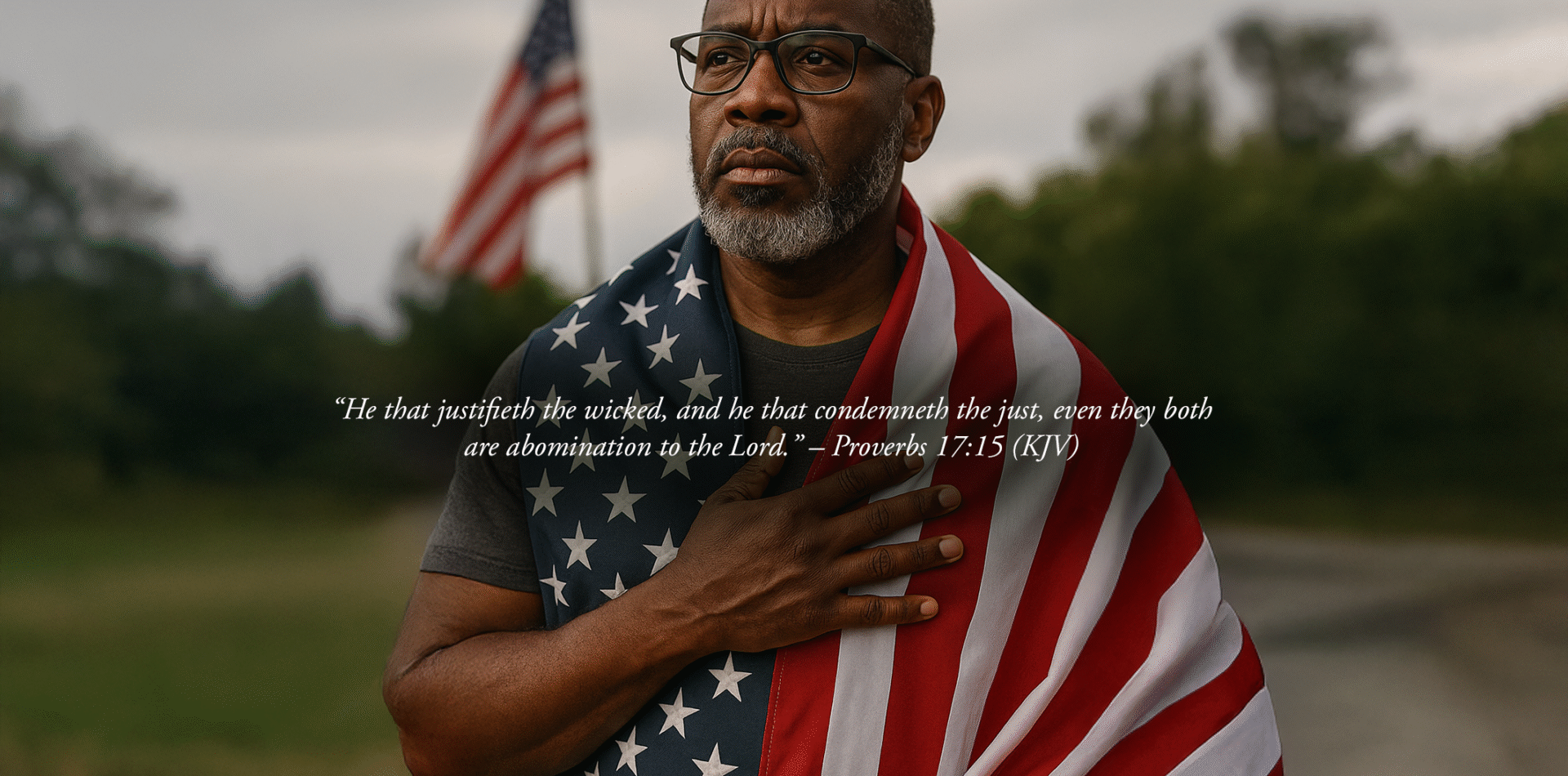
“He that justifieth the wicked, and he that condemneth the just, even they both are abomination to the Lord.” – Proverbs 17:15 (KJV)
“The heart of the righteous studieth to answer: but the mouth of the wicked poureth out evil things.” – Proverbs 15:28 (KJV)
“Wisdom is before him that hath understanding; but the eyes of a fool are in the ends of the earth.” – Proverbs 17:24 (KJV)
These verses are needed now more than ever. Every year, especially around holidays like the 4th of July, Thanksgiving, and Columbus Day, the social media timelines of Black Americans light up with tension. Some celebrate with joy and gratitude. Others respond with protest and grief. Some believe Black Americans should never honor a day that ignored the dignity of their ancestors. Others argue that celebrating these days betrays the cause of justice.
But the book of Proverbs warns us clearly: “He that justifieth the wicked, and he that condemneth the just, even they both are abomination to the Lord.” Both are equally offensive in God’s eyes, justifying the wrong, or condemning the right.
I hope you agree – the tension is real, and it is not going away anytime soon. In fact, it seems to grow stronger every year. I am not sure if you notice.
This article is not an attempt to force anyone to celebrate, nor to shame anyone who mourns. It is a plea for wisdom and discernment. For gospel-shaped thinking in an age of outrage, confusion, and shallow hot takes.
The founders of this nation declared liberty for themselves while denying it to others. In 1776, the Declaration of Independence proclaimed, “all men are created equal,” while hundreds of thousands of enslaved Africans were treated as property.
This contradiction is not imagined. It is documented. And it should be lamented, grieved, and mourned by the people of God, not ignored, dismissed, or downplayed. Why? Because what happened was not simply unfortunate
This contradiction is not imagined. It is documented. And it should be lamented, grieved, and mourned by the people of God; not ignored, dismissed, or downplayed. Why? Because what happened was not simply unfortunate or regrettable, it was unjust. And injustice is something God hates.
The Holy Spirit reminds us through Solomon,
“A false balance is abomination to the Lord: but a just weight is his delight.” (Proverbs 11:1)
This is not poetic language. It is divine judgment. God does not merely dislike injustice. He calls it an abomination. That means false systems, dishonest histories, and unequal treatment of human beings are not just social problems. They are spiritual offenses to the Creator of us all.
And because God hates injustice, so must His people. If we are to walk in love, the kind of love the Bible commands, we must remember that…
“Love rejoiceth not in iniquity, but rejoiceth in the truth.” (1 Corinthians 13:6)
We are not called to overlook evil, minimize it, or pretend it never happened. But neither are we called to meditate on darkness for its own sake. Paul reminds us to think on things that are true, just, pure, lovely, and of good report (Philippians 4:8).
Yet, remembering injustice does not violate those commands, it fulfills them. Scripture is full of moments when God called His people to remember hard things. Israel was told to set up memorial stones after crossing the Jordan (Joshua 4), to retell the story of their bondage in Egypt (Exodus 13:8), and to never forget how God delivered them (Deuteronomy 6:12). Jesus Himself instituted the Lord’s Supper as a regular remembrance of His suffering and death.
Biblical remembrance is not about staying stuck in the past. It is about learning from it, honoring truth, and guarding against repeating it. I believe, to ignore or forget the sins of slavery, racism, and systemic injustice is not spiritual strength, or emotional intelligence, it is moral negligence.
To justify a false version of justice is an abomination to God. And so is condemning what is right. We must remember, not to grow bitter, but to become wise. Not to seek revenge, but to walk in truth and repentance.
History, even in its most painful parts, is not outside of God’s control. While injustice may flourish for a time, while wicked men may appear to prosper, God is never absent, never indifferent, and never defeated.
Solomon reminds us,
“The lot is cast into the lap; but the whole disposing thereof is of the Lord.” – Proverbs 16:33 (KJV)
This proverb comes from a time when casting lots was a common way of making decisions (like drawing straws or rolling dice). But the point of the verse is not about chance, it’s about control. In Hebrew, the word “disposing” (or mishpat) means judgment, justice, or decision. In other words, even when something appears random, the outcome is still governed by God.
This means:
Even the evils committed during America’s founding were not invisible to God. And while the casting of lots (decisions made by men) produced systems that favored one group and oppressed another, God never lost control of the outcome.
So what does that mean for us?
It means we do not need to despair over the past or idolize it. We do not have to live in denial or in bitterness. We can move forward with confidence, not because America got it right, but because God is always right.
This is why we must not respond to July 4 with emotional reaction, tribal loyalty, or shallow slogans. We must respond with WISDOM.
And wisdom begins with asking: What would honor God most in how I approach this day?
“It is joy to the just to do judgment: but destruction shall be to the workers of iniquity.” – Proverbs 21:15
If you choose to rejoice in the freedoms God has allowed, freedom to worship, to gather, to preach, to work, to build, do so with discernment and gratitude. Do not confuse political liberty with eternal liberty. Do not celebrate blindly. Celebrate biblically.
I choose to celebrate. Not because America is righteous, but because God, in His mercy, has allowed me to live in a time where I can openly follow Christ, freely teach His Word, and raise my family with opportunities my ancestors were denied. I do not celebrate everything this nation has been, but I thank God for how He has preserved, provided, and positioned me in it.
“The blessing of the Lord, it maketh rich, and he addeth no sorrow with it.” – Proverbs 10:22
“Even a fool, when he holdeth his peace, is counted wise.” – Proverbs 17:28
You may choose to abstain from celebrating the 4th of July, not out of rebellion, but out of reverence. You may feel the hypocrisy in America’s founding documents. You may grieve the ongoing injustice. You may carry a burden for your people, or feel that joining in national celebration would violate your conscience.
That choice can be holy, if it is done unto the Lord.
Paul’s instruction to servants in Colossians 3:22-23 is instructive here. He told them not to serve merely to please their earthly masters, but to serve with sincerity and reverence, as an act of worship to God:
“…in singleness of heart, fearing God… and whatsoever ye do, do it heartily, as to the Lord, and not unto men.”
In the same way, our abstaining should not be driven by people-pleasing, peer pressure, or public protest – I hate following the crowd! It should flow from a heart that fears God more than man, and that seeks to honor Him above all. Even silence or separation can be an act of worship, when done from a place of reverence, not resentment.
But let us be clear: to abstain in humility is one thing; to abstain in pride is another. Fasting from fireworks is not a license to fire off self-righteous judgment. Silence can be a sign of wisdom. But scorning others is not.
This is where Proverbs speaks again:
“He that despiseth his neighbour sinneth: but he that hath mercy on the poor, happy is he.” – Proverbs 14:21
The application is clear: you can abstain from the celebration and still walk in love. You can reject the holiday without rejecting your neighbor. You can mourn the past without mocking those who choose to give thanks in the present.
In God’s eyes, how we do a thing often matters just as much as what we do.
If you choose not to participate, do it with grace. Do it with a quiet heart and a clear conscience. And let love, not pride, be what separates you from the crowd.
“The fruit of the righteous is a tree of life; and he that winneth souls is wise.” – Proverbs 11:30
There is a third path. Instead of either celebrating or abstaining, you may choose to redeem the day. That is, you may use the occasion as an opportunity to bear witness,not to a nation, but to, and for, the Kingdom of God.
This means you don’t gather simply to enjoy food, family, or fireworks. You gather with purpose. You speak with wisdom. You bring clarity to confusion. You turn conversation toward Christ, and use history to highlight the hope of the Gospel – the good news that Jesus came to set captives free, to bring justice to the oppressed, and to make all things new.
You might:
You do not need to wave a flag. But you do need to lift up the name of Christ.
This is what Paul had in mind when he wrote Romans 14. Some believers were eating meat. Others abstained. Some kept certain days. Others did not. Paul did not condemn either group: so long as each was acting in faith, with love, and “unto the Lord.”
“He that regardeth the day, regardeth it unto the Lord; and he that regardeth not the day, to the Lord he doth not regard it… Let every man be fully persuaded in his own mind.” – Romans 14:6, 5
This is the liberty we have in Christ – not a liberty to indulge the flesh, but a liberty to love, serve, and bear fruit in righteousness.
“Let us therefore follow after the things which make for peace, and things wherewith one may edify another.” – Romans 14:19
If God leads you to use this day as a chance to teach truth, promote justice, proclaim the gospel, or bring healing to the conversation, then do so boldly. Do so with grace. And do so with wisdom.
“The fruit of the righteous is a tree of life; and he that winneth souls is wise.” – Proverbs 11:30
You may not celebrate the flag. You may not mourn the holiday. But you can still bear witness. Because every day is the Lord’s day when it is used for His glory.
“The way of a fool is right in his own eyes: but he that hearkeneth unto counsel is wise.” (Proverbs 12:15)
There are two equal and opposite errors that have become all too common:
To celebrate America as if it has never sinned is not only ignorant; it’s idolatry! The nation is not the Kingdom. The Constitution is not Scripture. Christians who ignore America’s injustice while quoting its founders more than Christ are walking in darkness.
“Divers weights, and divers measures, both of them are alike abomination to the Lord.” (Proverbs 20:10)
The opposite danger is just as serious; a spirit of pride and self-righteousness. This takes two common forms:
Both are ditches. Both are dangerous. And neither reflects the wisdom of Christ.
“Whoso mocketh the poor reproacheth his Maker: and he that is glad at calamities shall not be unpunished.”
—Proverbs 17:5
“The fear of the Lord is the instruction of wisdom; and before honour is humility.”
—Proverbs 15:33
It is not righteous to act as if your grief is more holy than someone else’s gratitude. And it is not wise to condemn those in history who, like us, had blind spots. This continues to grieve me as I watch young followers of Christ, who are ignorant of Church History.
We must never excuse sin. But we must also avoid pretending we would have done better in their shoes. Many of the preachers, theologians, and missionaries I admire, men like George Whitefield, Jonathan Edwards, and others, failed to fully see or confront the evil of slavery. That grieves me. It should. But it should also humble me.
Because if Peter, the bold apostle, the man who walked with Jesus, the one who preached at Pentecost, needed a vision from heaven to finally abandon his prejudice toward Gentiles (Acts 10), who are we to act as if we see all things clearly?
Maybe this is why Proverbs says:
“Iron sharpeneth iron; so a man sharpeneth the countenance of his friend.” – Proverbs 27:17
We all need sharpening.
We all have blind spots.
We are all growing, if we are walking in the Spirit.
The same gospel that calls us to speak truth also calls us to show mercy. And the same gospel that humbles us about our sin must also shape how we think about the sins of others – past and present.
To quote again what we say so easily in prayer:
“Forgive us our debts, as we forgive our debtors.” (Matthew 6:12)
If we want mercy from God, we must be willing to show mercy to others.
Even to those who didn’t know better at the time.
And especially when we’re tempted to believe that we would have done better.
“To every thing there is a season, and a time to every purpose under the heaven.” (Ecclesiastes 3:1)
I celebrate the 4th of July because I believe in thanking God for common grace. I live in a land where I can raise my children, preach the gospel, launch businesses, mentor men, and disciple nations. I do not take that lightly.
But I also mourn. I mourn the blood that bought these freedoms unjustly. I mourn the stolen dignity of my ancestors. And I mourn the Church’s complicity in it all.
That mourning doesn’t make me less American. It makes me more Christian.
This section is not an emotional aside. It is an essential part of the healing, and, for some, the reconciling.
Because for many of us, especially those who love the Church, cherish sound doctrine, and have been shaped by the theological clarity of men from earlier generations, the pain is not simply in what America once justified, but in what much of the Church once ignored. The wound is not just national. It is ecclesiastical. It is theological. And for some, it is deeply personal.
As a student of church history and a lover of doctrine, I have benefited tremendously from the writings and ministries of men like Jonathan Edwards, George Whitefield, Richard Baxter, and many of the Puritans. Their sermons taught me to tremble at God’s Word. Their theological precision stirred my love for Christ. Their labor helped lay the foundation for my own convictions about God’s sovereignty, man’s depravity, and the necessity of regeneration.
But as I studied their lives alongside their works, I began to see areas where the light of their doctrine did not fully reach their conscience. And it grieved me.
Some of them owned slaves. Others defended slavery as an institution. Many were silent when they might have spoken prophetically. I did not question their salvation. Nor did I deny the fruit of their ministries. But I did wrestle.
I wrestled, not because I expected perfection from men, but because I did not understand how those who preached so clearly could remain so blind. I wondered how men entrusted with so much truth could fail to apply that truth to something so egregious. I wrestled, not with their theology, but with their humanity. And I grieved, not because they fell short of God’s glory (as all men do), but because their failure cost others so much.
“Open thy mouth for the dumb in the cause of all such as are appointed to destruction.” – Proverbs 31:8
That command is not metaphor. It is divine instruction. To remain silent in the face of oppression is to fail the test of justice. God holds His people accountable for whether or not they speak on behalf of the voiceless. And that accountability is not limited to their time. It speaks to ours.
So how did I move from confusion to clarity? From pain to peace?
God brought me to Peter.
Peter, the bold disciple, the water-walker, the Pentecost preacher, the one entrusted with the keys of the kingdom, was still struggling with ethnic prejudice after the Holy Ghost had filled him. The book of Acts reveals that he needed a vision from heaven to eat with Gentiles (Acts 10), and Galatians tells us he needed public correction from Paul for refusing to walk uprightly according to the truth of the gospel (Galatians 2:14).
“God hath shewed me that I should not call any man common or unclean.”
—Acts 10:28
Peter’s example gave me hope. It showed me that even Spirit-filled leaders, mightily used of God, are still in need of sanctification. That blind spots exist, even in those who see clearly in other areas. That God sometimes uses broken vessels to carry sacred truths, and that His mercy is big enough to work through them without condoning their failures.
If God could use Peter to preach Pentecost, lead the early Church, and open the door of faith to the Gentiles, while still confronting him for his hypocrisy, then surely God could use Edwards and Whitefield to recover doctrine, even while holding them accountable for what they failed to see.
“The discretion of a man deferreth his anger; and it is his glory to pass over a transgression.”
—Proverbs 19:11
To “pass over” a transgression does not mean to deny that it happened. It means, in light of mercy, to relinquish the right to vengeance. It is an act of spiritual maturity. A fruit of divine wisdom. A reflection of God’s own patience with us.
This is how I mourn. Not with unresolved confusion or historical bitterness. But with truth in one hand, and grace in the other. I mourn what was. I rejoice in what God redeemed. And I strive, by God’s grace, to walk in wisdom so that I do not repeat the blindness of the past under the disguise of righteousness in the present.
“Let every man be fully persuaded in his own mind… Let us not therefore judge one another any more: but judge this rather, that no man put a stumblingblock or an occasion to fall in his brother’s way.” – Romans 14:5,13
“Every way of a man is right in his own eyes: but the Lord pondereth the hearts.” – Proverbs 21:2
You may celebrate. You may abstain. You may use the day to witness. But whatever you do, do it unto the Lord and not for likes, views, or cultural approval.
America’s independence is not the believer’s ultimate freedom. That was purchased at Calvary. But as long as we live here, we must navigate these tensions with wisdom, not noise. With charity, not mockery. With courage, not compromise.
If we would see a better America, a freer Church, and a more faithful Black community, we must start not with fireworks or Facebook debates, but with the fear of the Lord.
Let the fool rage.
Let the wise build.
Let the righteous rejoice, and tremble.
Last modified: July 15, 2025
 When Helping Hurts: The Shocking Truth About What… June 9, 2025
  Welcome to The Proverbs 12X Advantage June 27, 2025
  Social Media Theology: Why It’s Not Enough—and Can… June 8, 2025
  How Proverbs Equips You to Multiply Without Compromise May 25, 2025
  What Should Black Christians Do on the Fourth of July? July 11, 2025
  Meditation, Contemplation, Revelation: The Forgotten… June 8, 2025
  What’s Wrong With Christian Parenting? The Hidden… June 27, 2025
  The First Domain You Must Conquer May 25, 2025
  Truth in Tension: Wisdom, Wealth, and the Poor June 9, 2025
  If You Don’t Let It BREAK You! You Will Get the… June 8, 2025